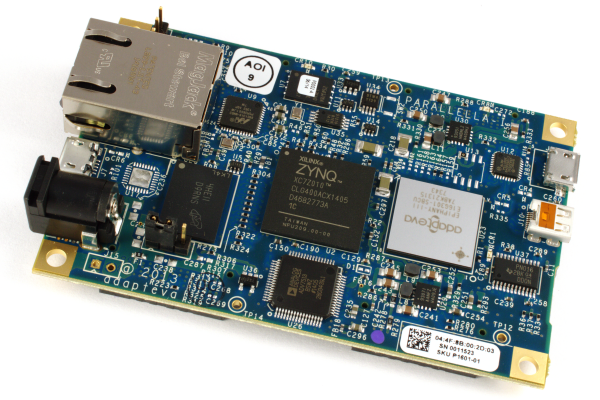
Having powered the Parallella board up and successfully logged in the next step is to look at the software environment which allow us to create our own applications. To do this we need the epiphany- software development kit (e-sdk) and there are a number of choices as to how we obtain this e-sdk. The simplest is to use an existing e-sdk…
Foreword by Andreas Olofsson: I have been following Adam Taylor’s MicroZed chronicles for a while and have been very impressed by the quality and quantity of his writing. Hopefully this will be the first of many great posts about the Parallella by Adam! ——– Article by Adam Taylor: You may be familiar with my blog over on Xilinx Xcell Daily…
I am thrilled to report that we have now shipped over 10,000 open source Parallella boards and they are being put to great use in parallel computing research projects all across the globe. It’s amazing to think that this parallel computing platform was created through a crowd-funded effort on Kickstarter! More details about active research areas for Parallella can…
The goal of the Parallella project is to democratize access to high performance computing and this is only possible if the whole world has the option to buy a Parallella board. Through the Kickstarter campaign and pre-orders Adapteva has shipped Parallella boards to over 2,000 customers in 75 countries but the logistical burden has been overwhelming. I am extremely pleased…
When we created the Parallella project on Kickstarter two years ago, the goal was to democratize access to high performance computing. To accomplish this goal, we knew that we had to make the Parallella platform completely open and as affordable as possible. 2012 Parallella Kickstarter Promises: Open Access: Absolutely no NDAs or special access needed! All architecture and SDK documents…
While the Parallella board is capable of delivering industry leading GFLOPS/watt performance (doing more with less energy), it is a small and densely populated board and it’s vital that adequate cooling is provided. Without which there may be temporary or even permanent failures. Kickstarter boards and those ordered via the Adapteva shop prior to 10th July came supplied with a…
When we launched the “$99 Parallella project” on Kickstarter in 2012, the goal was to “democratize access to supercomputing”. With a $99 price point, we knew that we would not make a profit, but we figured the value of reaching the whole world with our technology was enough of a reward for Adapteva as a company. With over 8,500 boards…
I am very pleased to announce the we have completed our Kickstarter and pre-order shipments and we are ready to reopen the Parallella shop this Friday at 1pm EST! Since January we have shipped over 8,000 Parallella boards to Kickstarter backers and pre-order customers all over the world and there are now 25,000+ people with expressed interest in purchasing a…
Brian Guarraci is a software engineer at Twitter and in his spare time he’s building a Parallella cluster with a design that was inspired by two of the most iconic supercomputers ever made. When we saw pictures of Brian’s cluster we were impressed and when we shared these with the community, it became apparent that we were not the only…
An introduction to how the Parallella board FPGA can be configured for “headless” operation (no HDMI controller) and alternative expansion. The Parallella’s Zynq chip provides not only a dual-core ARM processor and peripheral interfaces such as Ethernet and USB, but also a field-programmable gate array (FPGA) that greatly increases the flexibility of the platform. In Zynq parlance these are termed…